Still So Early
Better models arriving faster every month, the machinery underneath them rebuilt from the chips up, capabilities nobody planned for. We are not late to this. We are outrageously early.

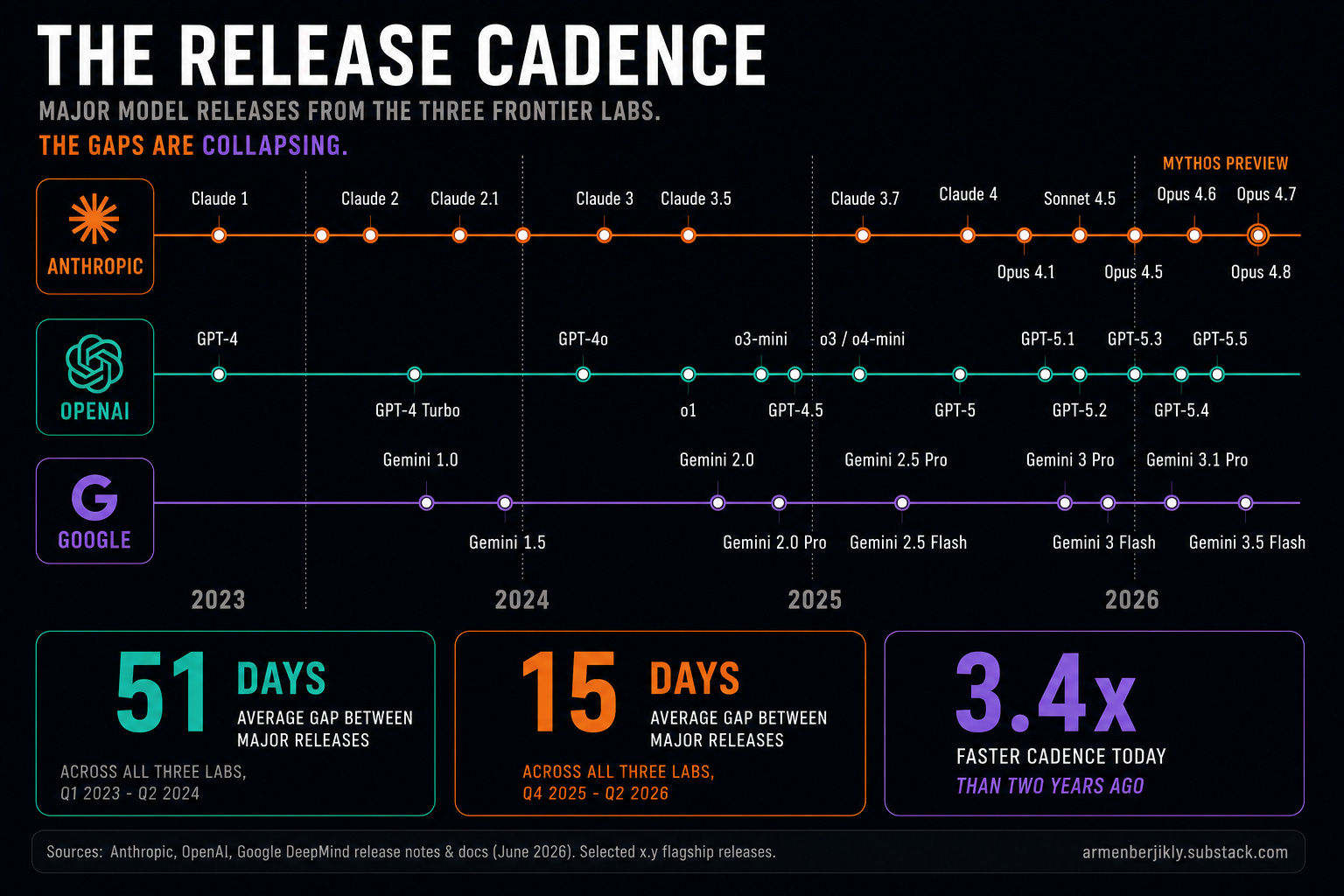
I gave a talk recently about where AI actually is. Early, late, middle. One slide got more “mmhmms” than any other. It was simply a list of the major AI language model releases from the previous few weeks: OpenAI shipping GPT-5.5, Google launching Gemini 3.5, Anthropic releasing Opus 4.8. Nobody in the room needed me to explain why the slide mattered. We were all living it.
Remember when GPT-3 first came out, and one model could dominate mindshare for months? Now a major release can feel old in a week. Hell, I can feel old every week. When I actually plotted it out, the average gap between major model releases across the three frontier labs has dropped from 51 days in 2023 to 15 days today. Roughly three and a half times faster, in eighteen months. And that follows a Q1 where the labs collectively shipped over 250 new models. Far from hitting a plateau, the pace of innovation is actually getting faster.
But the pace is not the interesting question. The interesting question, the one I really wanted to talk about before everyone vibed on the release cadence, is: are we late in the AI revolution, or are we still early?
After spending the last several months alternating between living two lives- one, internal enterprise AI transformation as a CTO, and the other, immersion in AI startups as an investor - I have a very clear opinion. We are not late. We are not even in the middle. We are still outrageously early.
Let me walk you through why, and why it matters whether you build software, run a business, or just want to prepare for what comes next.
Forget the benchmarks, watch the price.
A new model dropping every week is exhilarating, but it is also misleading. It makes us think the story is “models are getting smarter,” and so we fixate on the wrong question, which is whether the new one is really that much smarter than the last one (cue the engagement farmers asking “How many days of the week have a ‘d’ in them”). The frontier models are actually now so close together on the benchmarks that the answer barely matters. One scores 82.3 on ominously named tests like “Humanity’s Last Exam”, while the next scores 83.6. But nobody experiences that difference in real work, and our conclusion ends up qualitative, based on our own vibes of how its doing.
The actual story is in the economics, not raw intelligence.
The pattern that keeps repeating is as follows: State of the art performance is rare and expensive when it first ships, and then it quickly stops being either. It shows up in smaller, faster, cheaper models just a few months later. Anthropic’s Haiku 4.5, for example, came out about five months after Sonnet 4 was the state of the art, and it offered effectively the same performance at one third the cost and twice the speed.
Make sure you let that wash over you. One third the cost. Twice the speed. Time elapsed: A few months.
So, each frontier release does not just push the ceiling up. It leaves behind a trail of more practical models at economical pricing that suddenly make real workflows business-viable.
Then the question is not whether the very best model got a little bit smarter. The question is whether useful capability got cheap enough, fast enough, and available enough to spread into normal work. And the answer has been a resounding “yes” for over a year. The clearest recent proof came at Google’s annual I/O conference in May, when Google made Gemini 3.5 Flash the default in its app and in Search. Flash is the fast, lighter-weight tier, and this version beats the previous flagship Pro model on coding and agentic benchmarks while running about four times faster. The lighter model now outruns last cycle's premium model, in a single release cycle.
Stanford’s 2026 AI Index confirms the trend at the top, too: across major benchmarks, the leading frontier models are now separated by single-digit percentage points, and the U.S. lead over China is down to 2.7%.
In other words, having the single best model is no longer the prize people think it is. The race has moved on to who can make capability cheap, fast, and everywhere.
The capabilities keep showing up where nobody planned them.
Perhaps the strangest part of this whole moment is that the AI labs are themselves not fully in control of what their models can do.
In April, Anthropic created a model called Mythos (what a name!). They were trying to build a generally better model, the way every release is supposed to be better than the last. But when they tested it, they found it had quietly become an expert at finding security flaws in software, entirely unintentionally. It found a 27-year-old vulnerability in OpenBSD, an operating system whose whole reputation is built on being bulletproof. Code that experts and automated tools had picked over millions of times for decades, and this brand new model, built to tell you when Abraham Lincoln was born, and write an email, found the hole in an afternoon. Yikes.
Nobody asked for that. It came along for free, as a side effect of the model just being smarter across the board. And it was serious enough that Anthropic chose not to release the model widely, and instead worked with the government and major companies to get critical software patched first. The frame is clear: an AI lab built something so capable, by accident, that the only responsible move was to keep it under wraps. That is not a story about one model. It tells you how much room is left to discover what “better” even means.
The model is the tip of the spear
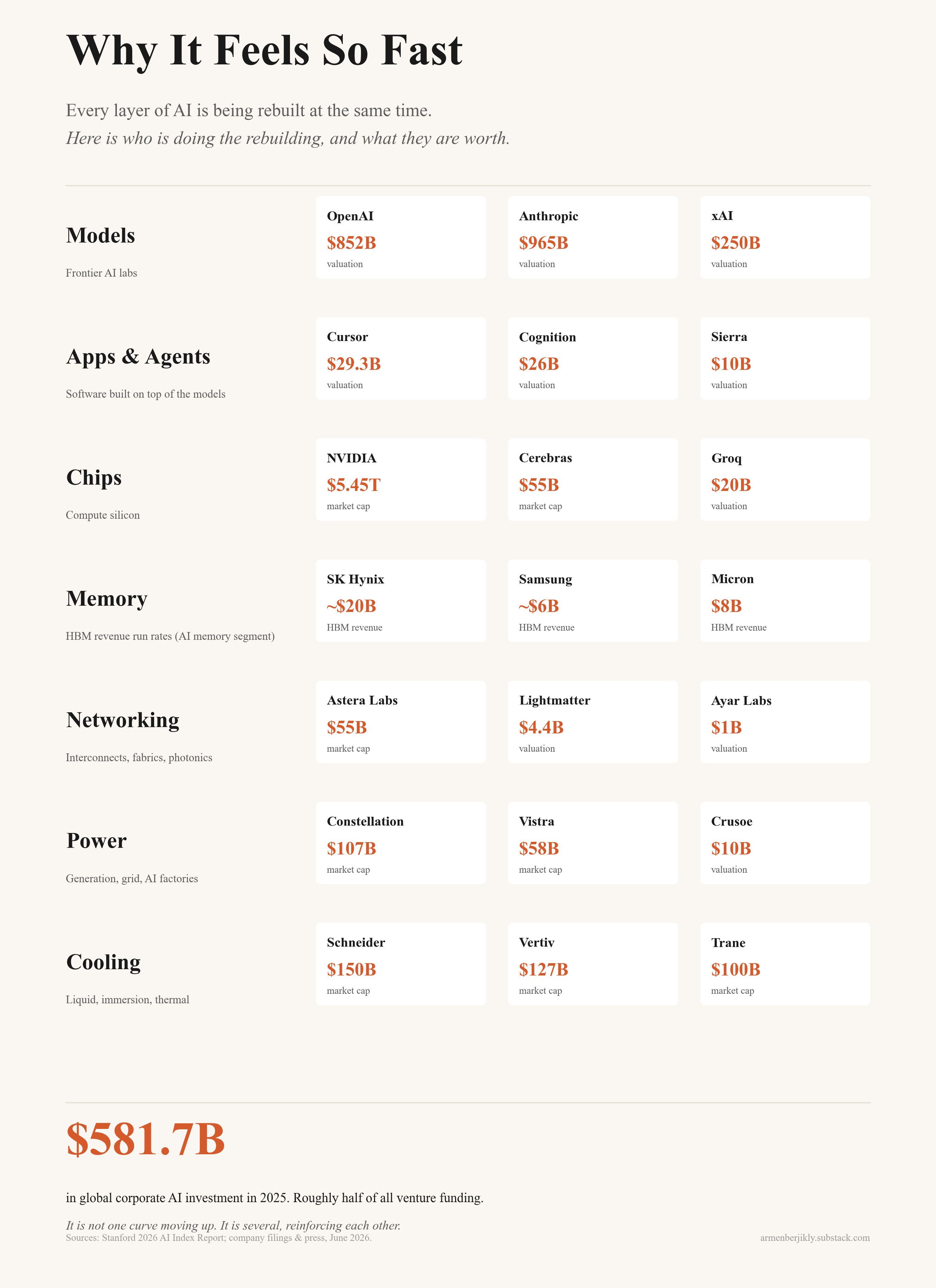
When you ask an AI to write something, you are talking to merely one layer of a very deep machine. Underneath the model sit the chips that do the math, the memory that feeds them data, the wiring that moves that data around, the power that runs it all, and the cooling that keeps it all from melting. You do not need to know how any of that works. You just need to know one thing: none of it is has been optimized or maxed out. None of it.
In fact, every one of those layers is being rebuilt right now, by hundreds of companies, with some of the most ambitious engineering talent on the planet, backed by near infinite capital. AI took close to half of all venture funding last year. Global corporate AI investment hit $581.7 billion in 2025, more than double the year before, and a huge share of it is going into the unglamorous layers nobody sees but everyone experiences when you hit ‘enter’.
That is a huge reason why this keeps speeding up, and an even bigger reason why it has no hope of slowing down. Even if the models stopped improving tomorrow (they absolutely will not), the machine underneath them would keep getting faster and cheaper all on its own. Better chips, better memory, better power, better cooling. And because those pieces sit at the foundation of the stack, every improvement multiplies everything above it. It is not one thing getting better. It is everything getting better at once, each piece pulling the others forward.
It is a flywheel, and it is just starting to spin. Opus 4.8, GPT 5.5, Gemini 3.5, Anything AI x.x, will be adorably small numbers in just a few month’s time.
So when people ask whether this pace can possibly continue, my answer is unequivocally yes. Not because one company will keep pulling rabbits out of hats, with Nobel-prize winning innovation, but because the entire machine around AI is still half-built and getting better in every direction at once.Like driving a race car at 25 miles an hour.
The funny thing about being early is that the problem is not the technology. The problem is us. We are barely using what we already have.
McKinsey found that only 1% of companies consider themselves mature in how they use AI, meaning it is actually woven into how they work and producing real results. One percent. Most people (maybe not you, but people you know) are still using these tools to draft an email, summarize a thread, clean up a document. That is genuinely useful. But it is a thin layer of help sitting on top of the way we already do things. It is not the deeper change that the technology already makes possible.
The next step is already here, and it’s often tagged as “agentic AI.” It was demonstrated by the nerd-culture moment a month ago where seemingly everyone was suddenly running their own 24/7 AI agent with OpenClaw or Hermes on Macbook Pros that disappeared off the shelves of deliriously happy Costcos and Best Buys.
While the utility of those first versions of agents are highly questionable, the truth is that tools are starting to take actions on your behalf, not just answer questions: booking, building, researching, working through multi-step tasks while you do something else. The reason we have not handed everything over to them yet is not really that they cannot do it. It is that we are still learning to trust them, still figuring out where to let them run and where to keep a human in the loop. That is a people problem and a habits problem, not a technology problem.
Which is the whole point.
For perhaps the first time in human history, the tools are no longer the thing holding us back. We are.
The capability is sitting right there, mostly unused, waiting for us to catch up to it. To be fair, this includes responsibly securing the technology so it doesn’t relentlessly and frenetically perform horrible things using our name.
Two things worth keeping an eye on
A couple of data points that stuck with me, because they cut against what most people assume.
The jobs picture is more specific than the headlines. Employment for software developers aged 22 to 25 is down about 20% since 2024, while older, more experienced developers are doing fine or growing. AI did not destroy the jobs. It ate the bottom rung of the ladder. That worries me, because the bottom rung is where the next generation learns the craft. If we automate away every entry-level task, we win this year and lose the decade. Anyone building anything serious right now should be thinking hard about how you bring new people in when the work they used to cut their teeth on is the work AI does first.
We are not as far along as the hype suggests. Generative AI reached more than half the population in three years, faster than the personal computer or the internet did. And yet the U.S. ranks 24th in the world in adoption, around 28%. Singapore is at 61%. The UAE at 54%. Whatever you assumed about who is ahead in this, the real numbers are stranger and more global than the story we tell ourselves.
The books are not written yet.
I have spent twenty-plus years building and investing in technology, and specifically in language models and AI. I cannot remember a time when the gap between what is possible and what people are actually doing was this wide. That gap is the opportunity, and it is open to everyone reading this, not just the people who work in tech.
If you build things, the bar is rising faster than your plans. The startups coming through YC right now are doing in weeks what used to take quarters. Move with that clock or get left by it.
If you work anywhere else, you do not need to become an engineer. You just need to get good at one habit: noticing the moments where this stuff could help. Find a task that is slow, repetitive, or annoying, and ask whether AI could do it better, or do something you could not do at all before. Ask that enough times, and you have quietly rebuilt how your work gets done.
And if you are just trying to keep up, take a breath. You are not behind. We are all early. The version of these tools you will be using a year from now will make today’s look quaint, and the price will be a fraction of what it is now. The whole thing keeps getting cheaper and better underneath us while everyone argues online about which model won this week.
This is the rare moment when the tools are moving fast and the books are not yet written. That is great news. It means we get to be the writers, not the readers.
Still so early. We can do this, and regardless, we have to do this because nothing is slowing down. Let’s go.