
Superintelligence, Sold Separately
The tools were the great equalizer. That era ended yesterday.

I spent all of yesterday with Claude Fable 5, Anthropic’s newest model, released to the public roughly 24 hours ago. It is, by nearly every benchmark that matters, the most capable AI any of us can buy. I also got told “no” more times in one day than my kids hear in a week.
Some background, because I feel this release offers a backstory worthy of its mythical naming.
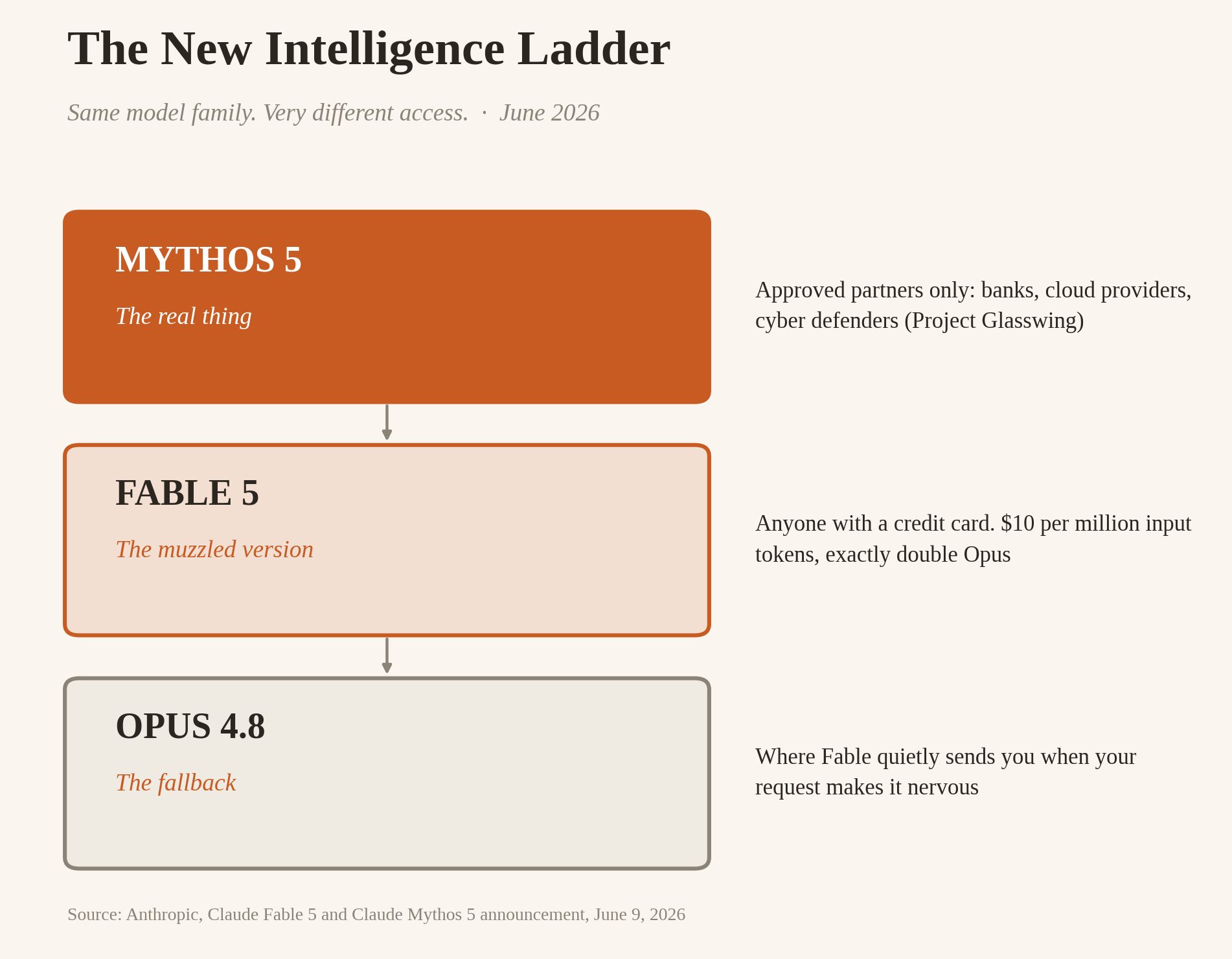
Fable 5 is the “famed” Mythos class of AI language model. In April, Anthropic unveiled a model so capable at finding software vulnerabilities that they refused to release it publicly, for fear it would hack its way into every vulnerable system on the internet. Instead they launched Project Glasswing, handing the model to a curated group of cyber defenders and critical infrastructure providers. Banks got it. Cloud providers got it. And the rest of us, well, we got blog posts and FOMO.
Two months later, the public version has arrived, and it’s… muzzled. When Fable 5 senses a request near the edge of its powers, it loudly bails and hands you off to last generation’s model, Opus 4.8 (demoted to consolation prize after all of three weeks on the throne). Anthropic says these safeguards trigger in under 5% of sessions, and admits they’re tuned conservatively. My personal experience: one day of normal work, with pretty typical requests caused me to hit the hard wall multiple times. “Conservative” is accurate framing.
Meanwhile, the unmuzzled version, Mythos 5, ships to the hand-picked partner club.
Is this better safe than sorry? Probably. Genuinely, even. I’ve spent enough time around security teams to know what a model like this can do in the wrong hands, and Anthropic deserves real credit for shipping carefully instead of shipping loudly. But the safety debate is the less interesting story here. The more interesting one is hiding in plain sight: for the first time in the history of software, the level of intelligence you can access depends on who you are. Whoa now.
The tools were the great equalizer
For my entire career, talent was the the most obvious inequality in tech. The best companies hired the best engineers, paid them outrageous sums, and fed them even more outrageous lunches, dry cleaning, et al. But everyone, from the two-person garage startup to the Fortune 10 giant, suffered through the same (geneerally awful) tools. Salesforce was Salesforce. Word was Word. Your CRM did not get smarter because you were richer. If anything, the scrappy upstarts had the edge, unburdened by seven-year enterprise contracts for software everybody hated.
That symmetry quietly died this week.
Now my AI partner might operate at “superintelligence” while yours runs a generation behind. Will it matter? Ask the engineers, because they’re going to vote with their feet. I can absolutely see great builders quitting jobs to go work with “the best” partner, whether they got locked out because their employer pinched pennies on model spend or because their company never made the early access list. We used to negotiate over compensation, mission, 401k match, and the quality of the snack wall.
Get ready for a new closing question in every interview: which models will I get access to?
Money talks, intelligence walks
In the terminal case, I think this divide gets decided more by spreadsheets and CFOs, than labs and politics. Fable 5 costs exactly double Opus: $10 per million input tokens, $50 per million out. That premium is a choice every CFO now gets to make, function by function, team by team.
Today, companies like OpenRouter optimize each individual LLM conversation, routing your question to the cheapest model that can plausibly handle it. Sensible. Tomorrow, that same logic climbs the org chart. Companies will decide which functions get which tier of intelligence. Engineering gets the frontier. Sales gets the frontier, because revenue. Legal gets last year’s model and a prayer. (To my dear friends in HR, you are so back to getting hosed...)
The org chart is about to become an intelligence chart. And unlike the salary bands we keep politely secret, this one will be impossible to hide. You’ll know within a week whether your AI partner is the “Best” Version, because your colleague’s will finish in one shot what your “Good” one fumbles in three.
Forward
None of this is doom. I’ve lived through enough platform shifts to know the spoils never distribute evenly at the start, and the start is exactly where we are. Access gaps create arbitrage, arbitrage creates opportunity, and opportunity has a habit of finding the people too stubborn to wait for permission.
No dull moments, nothing set in stone. Build your agency, bolster your optimism. No other way but forward.