
Not Everything Should Scale
A handmade souvenir from rural Armenia makes me question everything Silicon Valley teaches about optimization

I finally unpacked the souvenirs from the summer trip to Armenia, and my favorite piece sucked me into a classic “old vs new” battle royale playing out in my head. Man oh man, it’s beautiful, but what about the growth strategy?
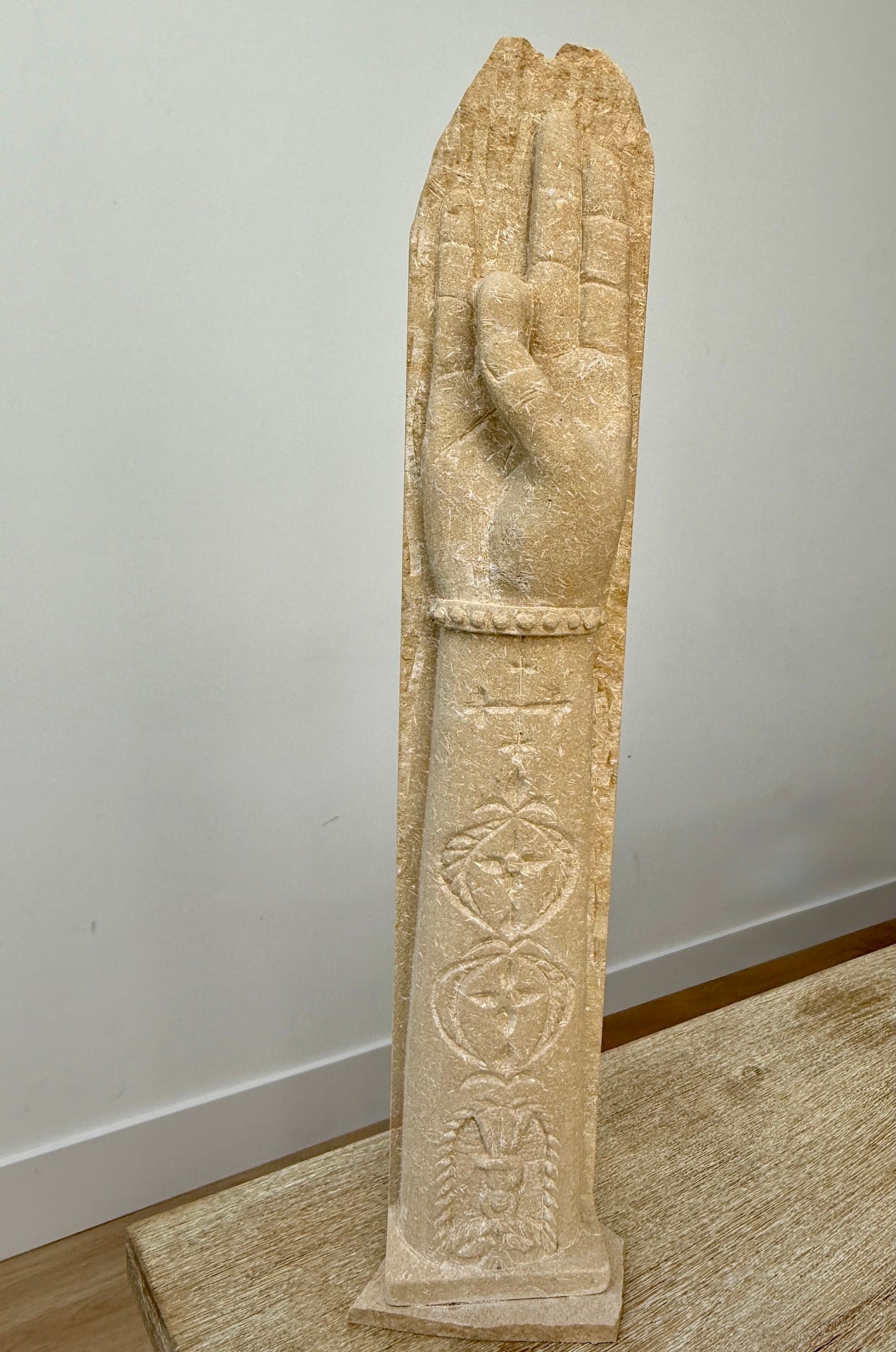
The piece is gorgeous—an ancient Armenian blessing captured in stunning limestone, carved from weeks of painstaking work by a brother duo of master artisans, Karen and Ruben Ghazaryan. But what's driving me crazy isn't the art. It's that my Silicon Valley brain is still firing off optimization questions three months after I bought it: "Why no online shop? How does this scale? Why two hours from the capital, Yerevan? Who’s running their socials?"
Artisans in a Mountain
The shop- the only place they sell their wares- is tucked into Noravank, Armenia, a far-flung corner of a far-flung country. We'd driven hours on sometimes “interesting” roads to reach a church that’s carved entirely out of stone (yes). The store we randomly walked into was blissfully air conditioned, humid, and smelled like stone dust and church. Simple tools- hammers, chisels and the like- were laid out in the corner on partially complete pieces. Incredibly unique sculptures, for once not limited to the tourist tropes of pomegranates and crosses, were displayed proudly throughout.
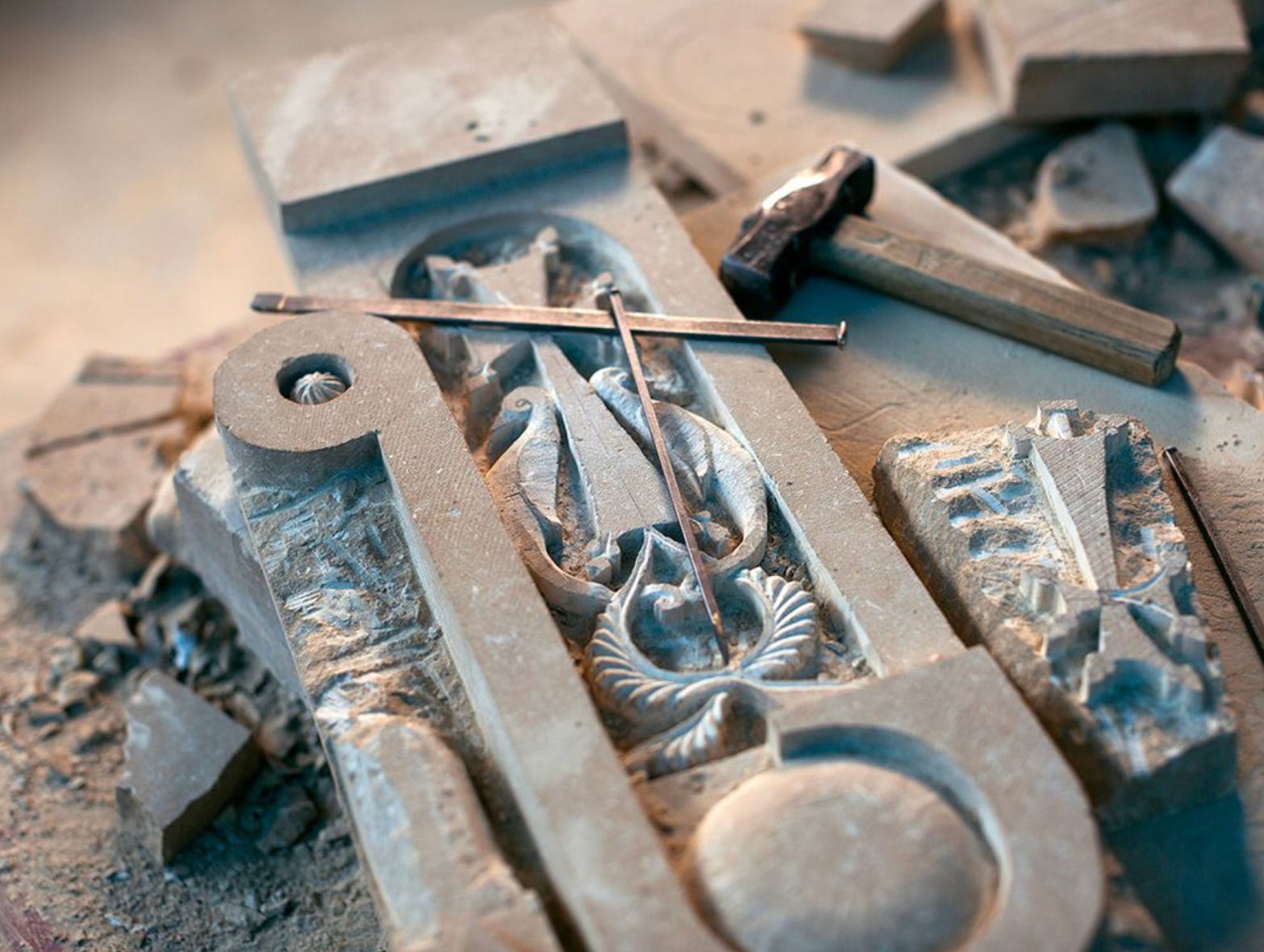
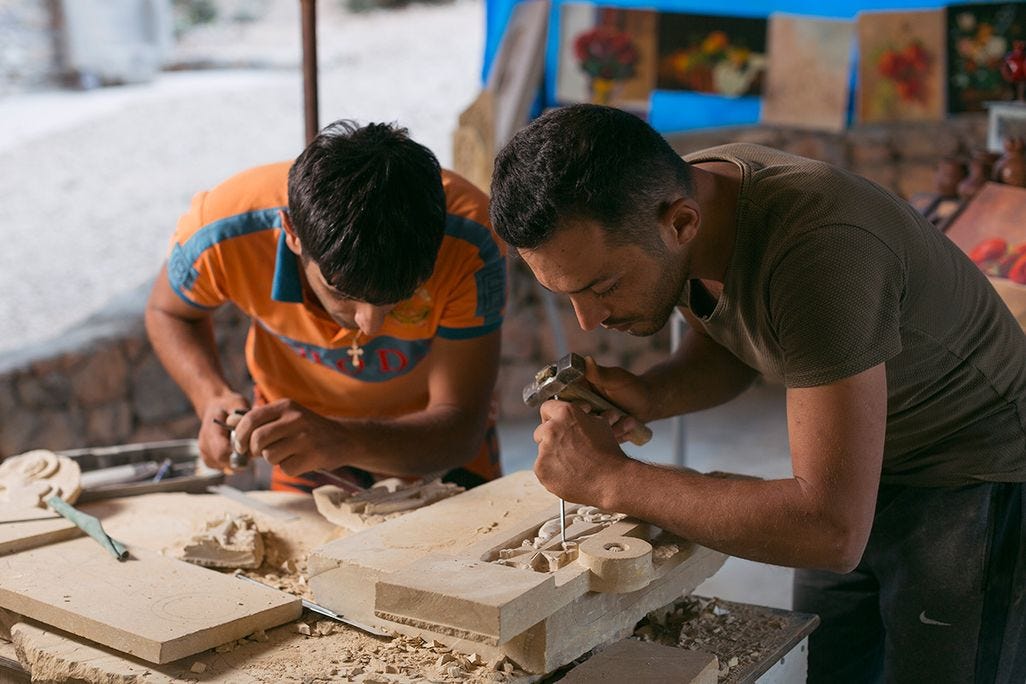
Karen Ghazaryan ultimately didn't just sell us some statues. For over an hour, he walked us through his life story—how he and his brother opened a shop here, close to their home village, to pursue their passion for traditional stone carving and maybe, just maybe, to teach their kids the art. His eyes lit up explaining the backstory and time spent on some of his showcase pieces. Rather than try to get us to just buy stuff and move on, he lingered. His wife emerged from outside, her own paintings (of cats!) also eye-catching in their own right. Somehow we found ourselves in a conversation about art, family, and what it means to create something meaningful. When we finally went to check out, he gave us an unasked for discount.
My kids were (for once) enchanted. My wife went on a shopping spree. I was both of those things, but also... calculating unit economics?!
"Why is this shop so hard to get to? Where is the online strategy? Why is he burning so much time talking to me? How can the math, math if he can only carve X pieces in Y time? "
Two Ways of Seeing the World
Twenty+ years in Silicon Valley as a founder and VC, have given me a very particular lens for viewing the world. These glasses are, I believe, incredibly powerful for value creation, and the byproduct of a restless mind that always believes we can improve everything.
Every experience gets filtered through frameworks that help me spot opportunities: How do you scale this? What's the addressable market? Where are the inefficiencies? Can technology eliminate bottlenecks? This pattern recognition has helped me identify, start, and invest in companies that have gone on to create thousands of jobs and enormous economic value.
But standing in Karen’s workshop, I realized there's another equally valid way of seeing the world. What if some things just aren't meant to be optimized, at least, not commercially? What if the constraints that my “VC brain” immediately wants to solve for are actually features, not bugs?
What if Karen’s workshop being two hours from the capital city of Yerevan isn't a distribution problem—it's the entire point? What if the hour-long conversation about each piece isn't (delightful, but…) super-inefficient customer service, it's actually what makes the experience irreplaceable and the product so meaningful?
When Scale Serves Us (And When It Doesn't)
The venture capital approach to building companies has given us incredible innovations. When you need to connect billions of people, deliver software globally, or solve problems that require massive coordination, optimization and scale are exactly what you need to succeed.
But we've become so good at this approach that we (ahem, I) sometimes apply it everywhere, even where it doesn't belong. If you’re pitching a VC, you often want to avoid business models that require deep human touch (it’s not scalable or replicable). And VCs are hired to fund “power-law outcomes” where you need to swing for the fences on the largest possible business. Steady businesses, profitable as they may be, rarely fit that mandate.
Meanwhile, the brothers Ruben and Karen are carving stone by hand, one at a time, in a mountain workshop with the stunning backdrop of the world’s oldest winery and a national park reminiscent of Devil’s Postpile. Their approach serves a completely different but equally important purpose—preserving tradition, creating meaning, and building genuine human connection from parent to child, local to visitor, ancient to modern.
What We're Actually Optimizing For
So after months in my luggage, I finally unwrapped my souvenir, which brought back this flood of memories, and triggered the sense that you can still optimize, just for different outcomes. Both kinds can work in harmony.
The brothers aren't trying to maximize shareholder value. They’re trying to preserve a 2,000-year-old tradition while providing for their families and creating something truly beautiful. They’re optimizing for meaning, mastery, and connection. The output of being in a state of flow. These are metrics incompatible with cap tables and board rooms.
The "business model" is simple: make something extraordinary, tell its story, and charge what it's worth. No growth hacking, no customer acquisition funnels, no SAFE to raise money with. Just craft, conversation, and community.
And, well… it works! Not at a venture scale, but at a human scale. And there’s absolutely nothing wrong with that.
The Things That Don't Scale DO Matter
This is absolutely not a romantic argument against technology. I embrace it with every fiber of my being. AI will change everything, and I believe it will predominantly be for the better. And AI is just the current “thing” - soon enough, quantum computing will solve problems we can't imagine, fusion energy might save the planet, humanoid robots will become pervasive. We humans are incredibly gifted at creation.
But these tools are ultimately means to an end. Technology was invented to help humans do the things we aspired to but struggled with. It should never make us fundamentally less human, or less important. They can't replace the satisfaction of creating something with your hands, the intimacy of a conversation with someone who's dedicated their life to their craft, or the joy of discovering something extraordinary in an unexpected place.
Not every founder needs to be posting daily on X about their growth metrics. Not every business needs to scale to a billion users. Not every moment needs to be optimized, automated, or turned into content. Some things are kind of perfect exactly as they are.
What This Means for How We Build
I'm not suggesting we should stop seeking scale where it makes sense. The world needs both approaches. When you're solving global problems or building infrastructure that serves billions, the venture model is exactly right. But maybe we can also get better at recognizing when a different approach serves the world better.
Maybe some businesses are perfect at their current size. Maybe some problems are best solved by skilled humans rather than software. Maybe the most important innovations aren't always the ones that can reach a billion users. The pressure to conform to *scale* for scale’s sake, to keep up with the “Joneses,” to “matter” is real, but empty.
The next time I'm in a pitch meeting and a founder says, "This doesn't scale, but..." I want to lean in instead of immediately calculating why that's a problem. Some of the most important things we do, like raising kids, building relationships, creating art, preserving traditions, are inherently unscalable, and we would all agree, infinitely valuable challenges. Perhaps the most important takeaway is recognizing which approach serves the moment.
Thanks Karen and Ruben. That stone blessing now sits proudly on my desk, and provides infinite inspiration for a balanced worldview.
Karen and Ruben Ghazaryan are super stars. You can learn more about them in this Smithsonian piece dedicated to their work. And if you find yourself in Armenia, please visit their store and buy everything you can. It’s here.
"optimizing for meaning, mastery, and connection" 🧡
I find myself doing this as well and tell myself to slow down. Also that was a very mini shopping spree.